Irvine, Orange County, California
Irvine Pool, Spa & Landscape Construction
Blue glass, edge to edge. And a gold line on every step.
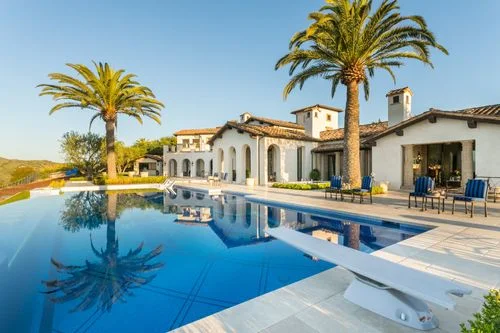
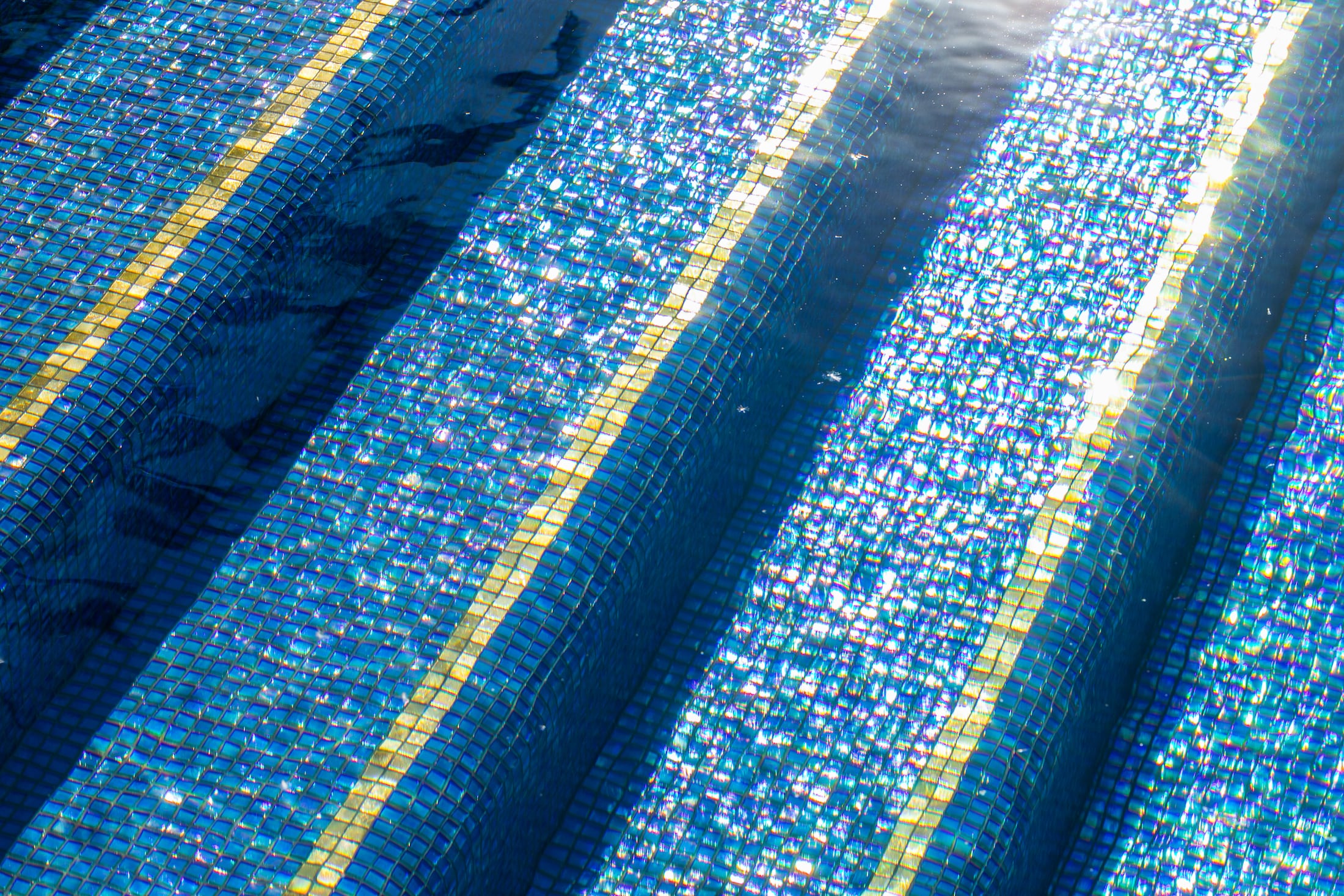
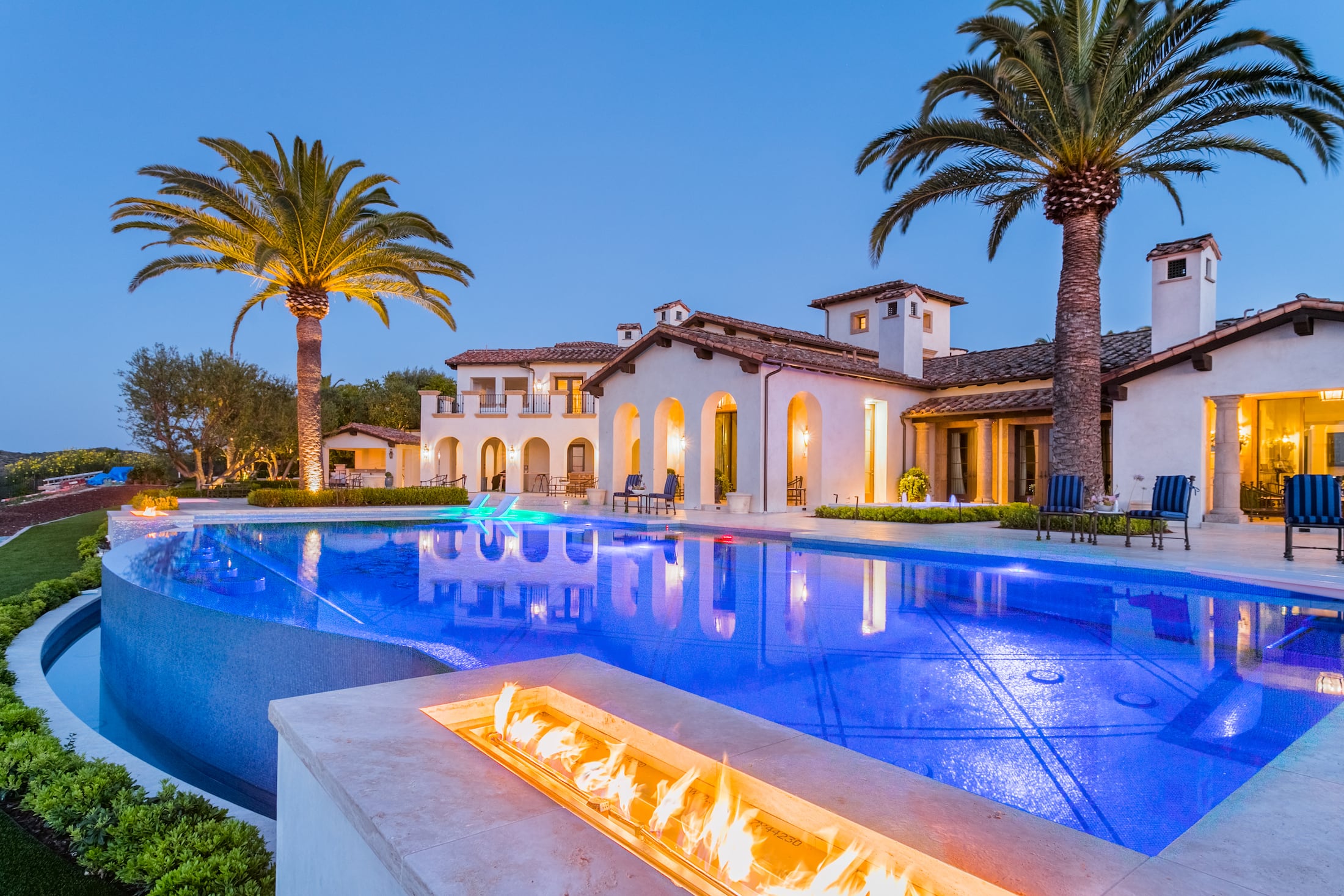
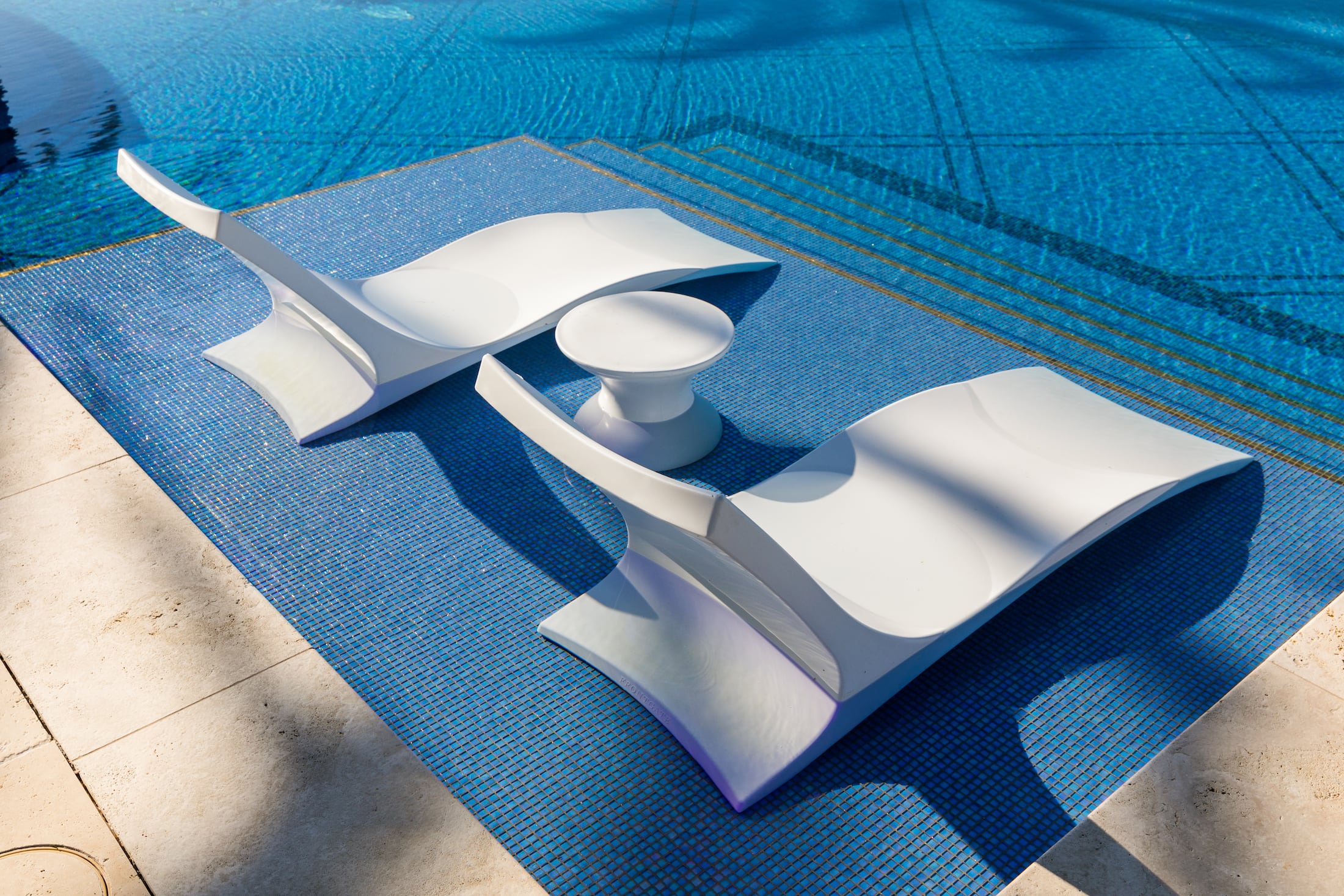
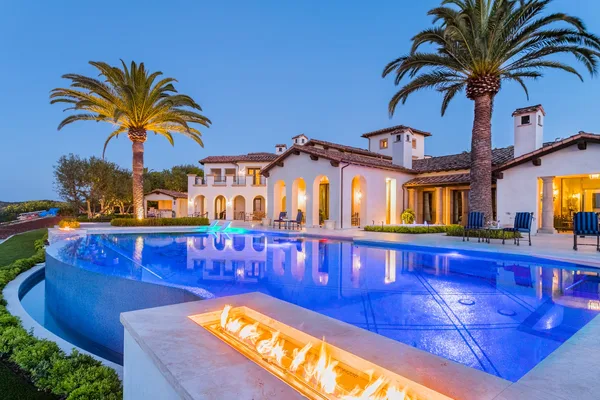
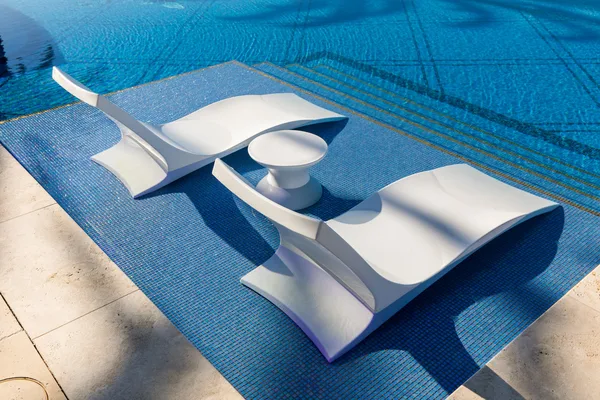
This Irvine pool is finished entirely in blue glass mosaic tile. The floor, the walls, the steps, the sun shelf, the benches and the curved infinity edge are all tile. The surface reflects the house and the palms like a mirror, and under the water each step is marked with a narrow band of pale gold. White sculpted loungers sit on the sun shelf. A linear fire feature runs beside the water. The surrounding landscape includes a pergola, a mosaic-paved courtyard, fountains, olive trees and a stone fire pit.
This case study explains how an all-tile pool is built, why the preparation under the tile matters more than the tile itself, and how a step edge is made visible without spoiling a field of blue.
At a glance
- The setting: A hilltop estate in Irvine with long views and mature palms.
- The scope: All-tile pool with curved infinity edge, spa, sun shelf, submerged seats and stools, contrasting step bands, linear fire feature, pergola, courtyard paving, fountains, planting and lighting.
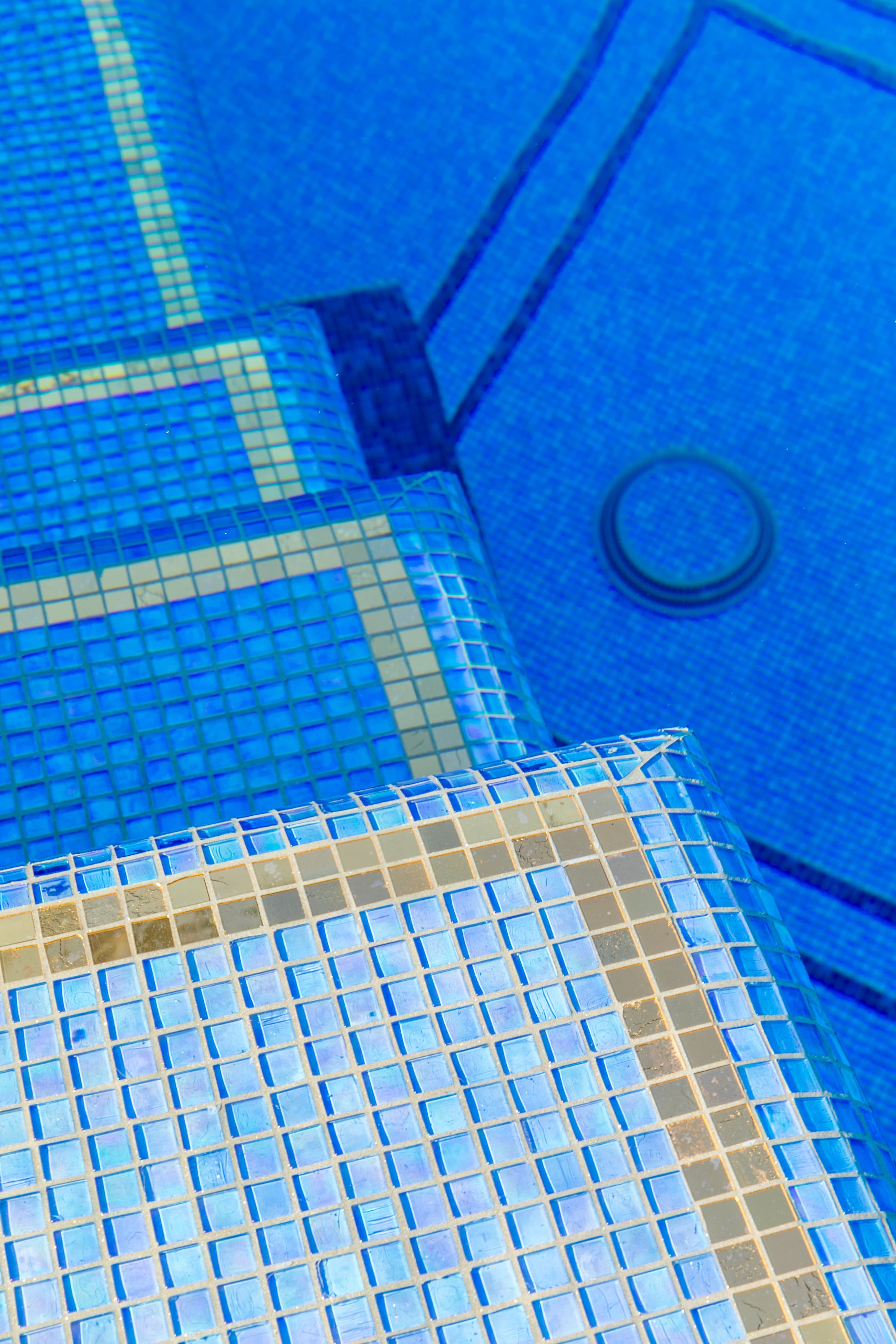
- The signature detail: A narrow pale-gold mosaic band on the edge of every tread, mitered around each corner.
- Location: Irvine, Orange County, California.
The color is the pool.
Most pools are finished in plaster or pebble, with a band of tile at the waterline. An all-tile pool is a different object. Glass mosaic has depth. Light passes into each piece and comes back out, so the water looks more saturated, and the color shifts through the day as the sun moves. In the morning the pool is a pale, bright blue. At dusk, with the lights on, it is close to cobalt.
That depth of color creates one practical problem. A step finished in the same blue as the floor can be hard to see through moving water. The answer on this pool is a contrasting band at the nose of each tread. The band is narrow, so from across the yard the pool still reads as one field of blue. Up close, looking down from the deck, each step is outlined.
The white loungers on the sun shelf show the same idea at a larger scale. Pale shapes on blue tile read clearly through shallow water.
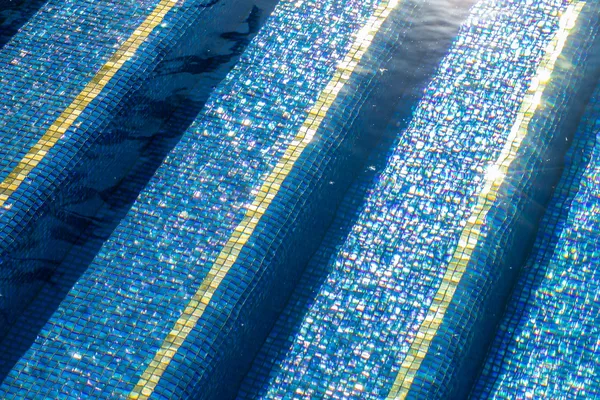
Why finish a whole pool in glass tile?
- Color and depth. No other finish gives the same saturated, luminous water.
- Longevity. Properly installed glass tile does not wear the way a cementitious finish does, and it does not need to be resurfaced on the same cycle.
- A smooth surface. Tile is comfortable on feet and easy to brush clean.
- Precision. Steps, benches and edges can be drawn as crisp geometry, because the finish follows the form exactly.
The trade is time and care. An all-tile pool takes far longer to finish than a plaster pool, and the substrate has to be close to perfect before the first sheet is set.
The build, layer by layer.
01. Design to the tile module
Small mosaic looks best when it lands on whole pieces. We size treads, risers, benches and the sun shelf to the tile module where we can, so edges finish on full tiles. The location and width of the contrasting bands are drawn at this stage, including how they turn each corner.
02. Build a shell made for tile
The pool is excavated, formed, reinforced and plumbed, and the shell is placed in shotcrete. For a tile finish, the shell is shaped with the thickness of the waterproofing, float and tile allowed for, so the finished dimensions come out as drawn. The concrete is kept wet through the early cure and then given time to dry and settle before any coating is applied.
03. Prepare and waterproof the surface
Glass tile shows everything behind it. The shell is cleaned and prepared, and the entire interior is waterproofed with LATICRETE HYDRO BAN. Waterproofing in a tile pool does two jobs: it keeps water in the pool, and it protects the bond between the tile assembly and the concrete.
04. Float every surface flat
A LATICRETE 3701 fortified mortar bed is applied over the whole interior and worked to flat planes, straight edges and true curves. This is slow, skilled work. Small mosaic follows every hollow and hump, and light on water exaggerates them. The float is checked with straightedges on the flats and with templates on the curved infinity edge.
05. Lay out from the most visible lines
Setting starts where the eye goes first: the waterline, the step edges and the top of the infinity wall. Full sheets are placed on those lines and cuts are moved to the least visible places, usually the floor-to-wall transition. The gold bands are set with the treads, not added afterward, so the joints run through.
06. Set the glass
Glass mosaic is set in LATICRETE 254 Platinum with full coverage behind every piece. Coverage matters more with glass than with any other tile, because voids show as shadows through translucent pieces. Sheets are aligned to each other so the sheet pattern disappears in the finished work.
07. Turn the corners
Corners are where a tile pool is judged. At each step, the gold band has to turn ninety degrees and keep its width. At the benches and the round submerged stools, the tile has to follow a curve without opening the joints. The portrait photograph of the steps shows a band turning a corner cleanly, with the blue field continuing on both sides.
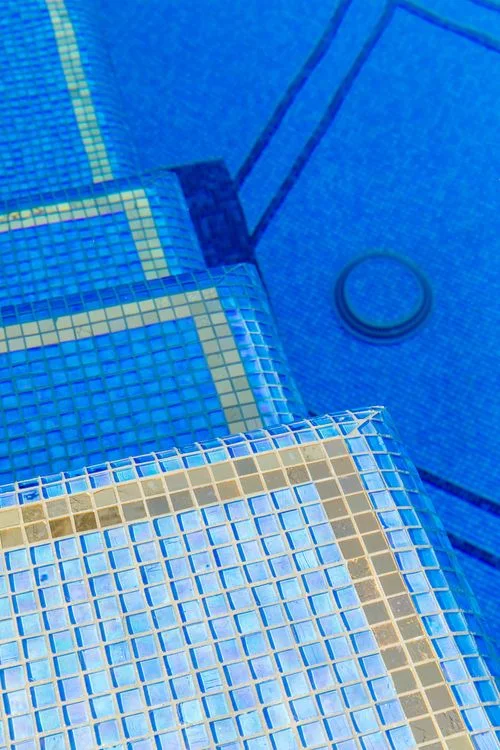
08. Grout, cure and clean
Grout is chosen for submerged use and for color. A grout close to the tile color makes the field read as solid blue. After grouting, the assembly is given the full cure time the manufacturer calls for before the pool is filled. Filling early is one of the most common causes of tile failure, and waiting costs nothing but days.
09. Build the fire feature and the deck
The linear fire feature beside the pool is built with its gas supply, burner and drainage to the manufacturer's requirements. The surrounding deck is laid over a concrete subbase with slope away from the pool, and the coping is set to a level line, since still water will show any coping that is not.
10. Fill, start up and hand over
The pool is filled, started and balanced. With a tile finish, water chemistry is about protecting the grout and keeping scale off the glass. We test the infinity edge flow, the spa, the lights and the fire feature, complete inspections, and walk the owner through care and operation.
Where all-tile pools go wrong, and how we avoid it.
Tile over an uneven shell. If the float is skipped or rushed, the tile follows every wave in the concrete, and the walls shimmer unevenly in the light. We float the entire interior, not just the waterline.
Poor coverage behind glass. Voids behind glass tile are visible and they are weak points. We use the thin-set and the trowel method the tile and setting-material manufacturers call for, and we check coverage as the work proceeds.
Filling before the cure is complete. Setting materials and grout need time to reach strength before they are submerged. We hold the fill until that time has passed, even when everyone is eager to see water.
Steps that vanish. A dark or saturated tile without edge marking makes steps hard to read. We mark tread edges with a contrasting band and check the effect in daylight and with the pool lights on, since most families use the pool at both times.
Chemistry treated like a plaster pool. A tile pool does not need the aggressive startup a new plaster pool gets. We give the owner and their service company the manufacturer's guidance for tile and grout.
Blue from every angle.
From the house, the finished pool is a sheet of reflective blue with palms in it. From the deck, it is a set of clear steps and shelves outlined in gold. From the far side, the curved infinity edge drops away to the view. All of it comes from one material, set over a carefully prepared surface.
More photographs, including the courtyard paving, the fountains and the pergola, are in the project gallery.
Caring for a glass tile pool.
A glass tile interior is durable and easy to live with, provided the water is looked after. The aim of water chemistry in a tile pool is to protect the grout and keep the glass free of scale. Keep pH, alkalinity and calcium within the ranges the tile and grout manufacturers recommend, and test regularly. Water that is out of balance in one direction slowly attacks grout. Out of balance in the other, it leaves a white mineral film on the tile, which dulls the color that the pool was built for.
Brush the walls and steps with a soft brush. Do not use steel brushes or abrasive pads on glass. At the waterline, wipe away body oils and sunscreen before they build up, using a cleaner that the tile supplier approves. If scale does appear, have it removed by a service company with experience in glass tile, since aggressive methods can scratch the surface.
The infinity edge should run often enough to keep the catch basin water fresh and filtered. Check the basin for leaves, and check that the automatic fill is working, especially in hot or windy weather when the edge loses more water. The in-pool loungers on the sun shelf should be rinsed and, if they are the fillable type, kept full so they stay in place.
Look over the grout once a year, with the pool lights on at night, when small gaps are easiest to see. Small grout repairs made early are simple. The gold step bands should be checked at the same time, since they are there to be seen.
We do not provide weekly pool service. We are glad to recommend service companies that are experienced with all-tile pools, and we give them the manufacturers' care guidance at handover.
What would you change about your pool?
- Retiling an existing pool in glass mosaic
- Adding contrasting bands to steps that are hard to see
- Adding a sun shelf with in-pool loungers
- Building submerged seats, stools or a swim-up counter
- Adding a linear fire feature beside the water
Questions homeowners ask about all-tile pools
Is an all-tile pool worth it?
It depends on what you value. Glass tile gives color and depth that plaster and pebble cannot match, and a properly installed tile interior lasts a very long time. It takes longer to build and the preparation is demanding. We explain the difference in the complimentary scope of work and budget so you can compare.
How do you make pool steps easy to see?
We set a band of contrasting tile along the edge of each tread. On a blue pool, a pale or warm-colored band reads clearly through moving water. Many jurisdictions also have their own requirements for marking step edges, and we follow the local code.
What do you use to set pool tile?
We use the LATICRETE system on waterline and submerged tile: HYDRO BAN waterproofing, a 3701 fortified mortar bed to flatten the surface, and 254 Platinum thin-set.
Can an existing plaster pool be converted to tile?
Often, yes. The existing finish is removed, the shell is evaluated and repaired, and the surface is waterproofed and floated before tile. The steps and benches can be reshaped at the same time.
Love your home. Rethink your yard.
Every project begins with a complimentary site visit. From that visit we prepare a complimentary, detailed scope of work and budget, so you know what the project includes before any design work starts.
Request a Complimentary Site Visit. Call 800-808-7510 or email info@richardlusk.com.
Richard Lusk Landscape and Design has been building pools and landscapes since 1976, with more than 3,000 projects completed. California contractor license 950714, C-27 Landscaping and C-53 Swimming Pool. Bonded and insured. Serving Orange County, selected Los Angeles communities and La Quinta.