Orange County, California
Contemporary Outdoor Living & Hardscape in Orange County
No swimming pool. Just water, stone, fire and plants.
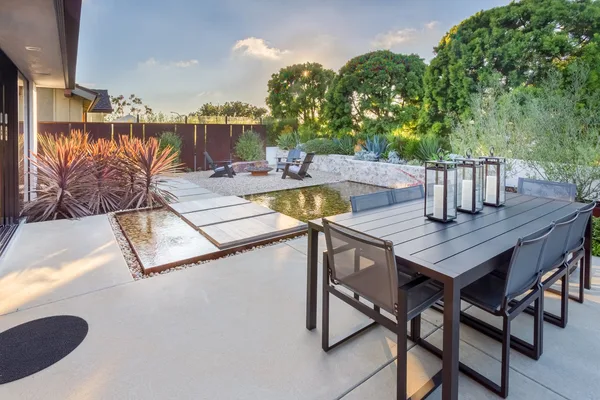
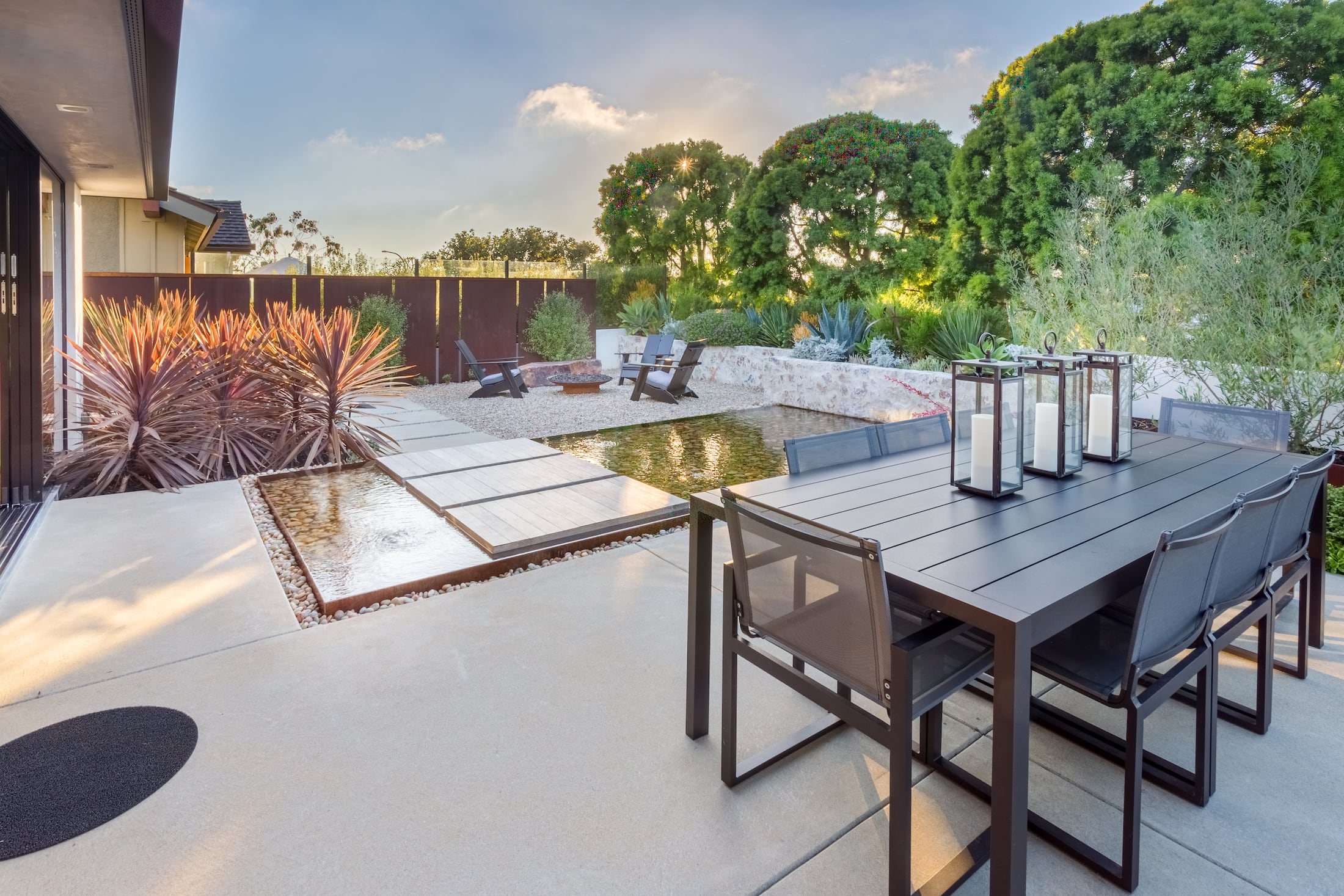
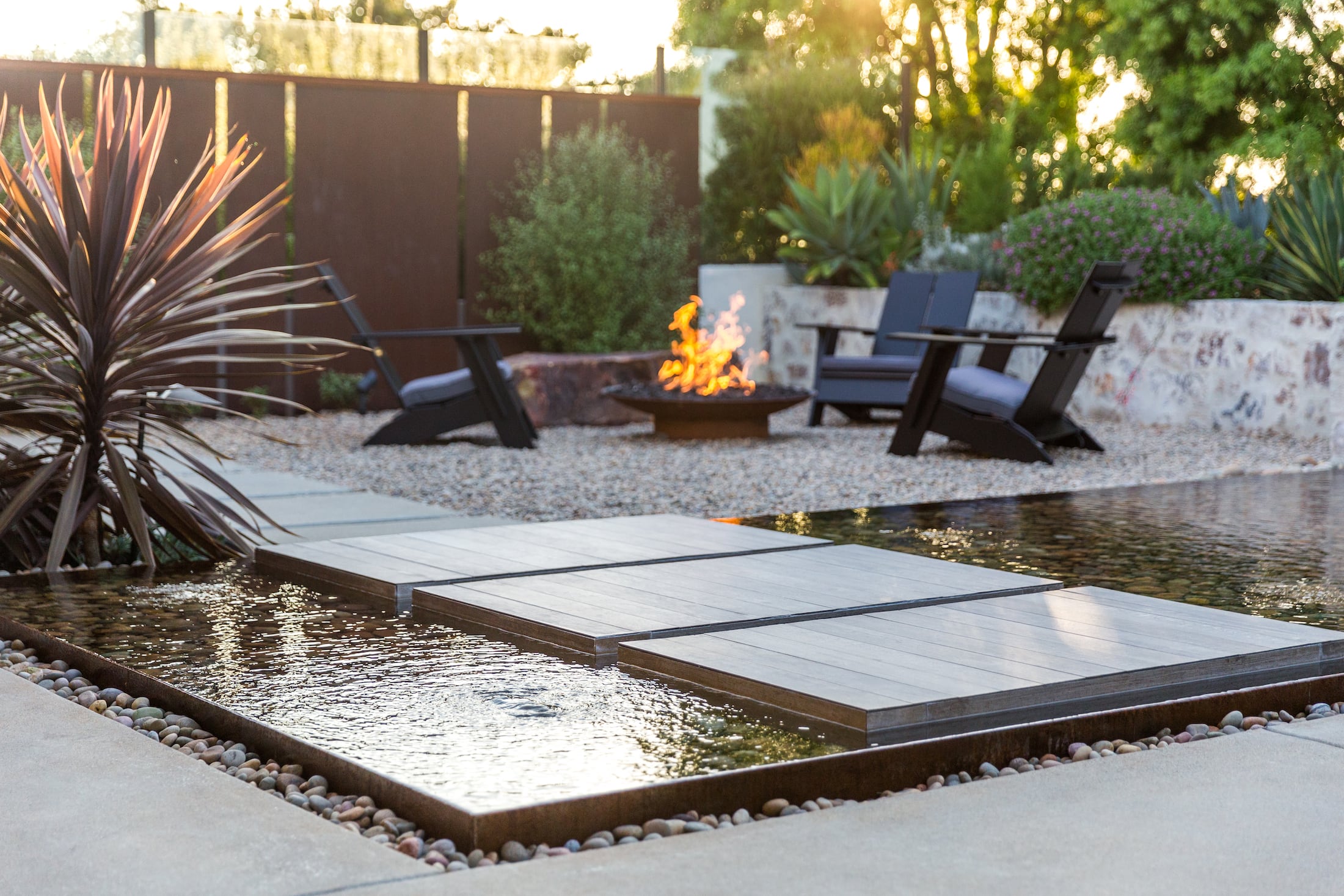
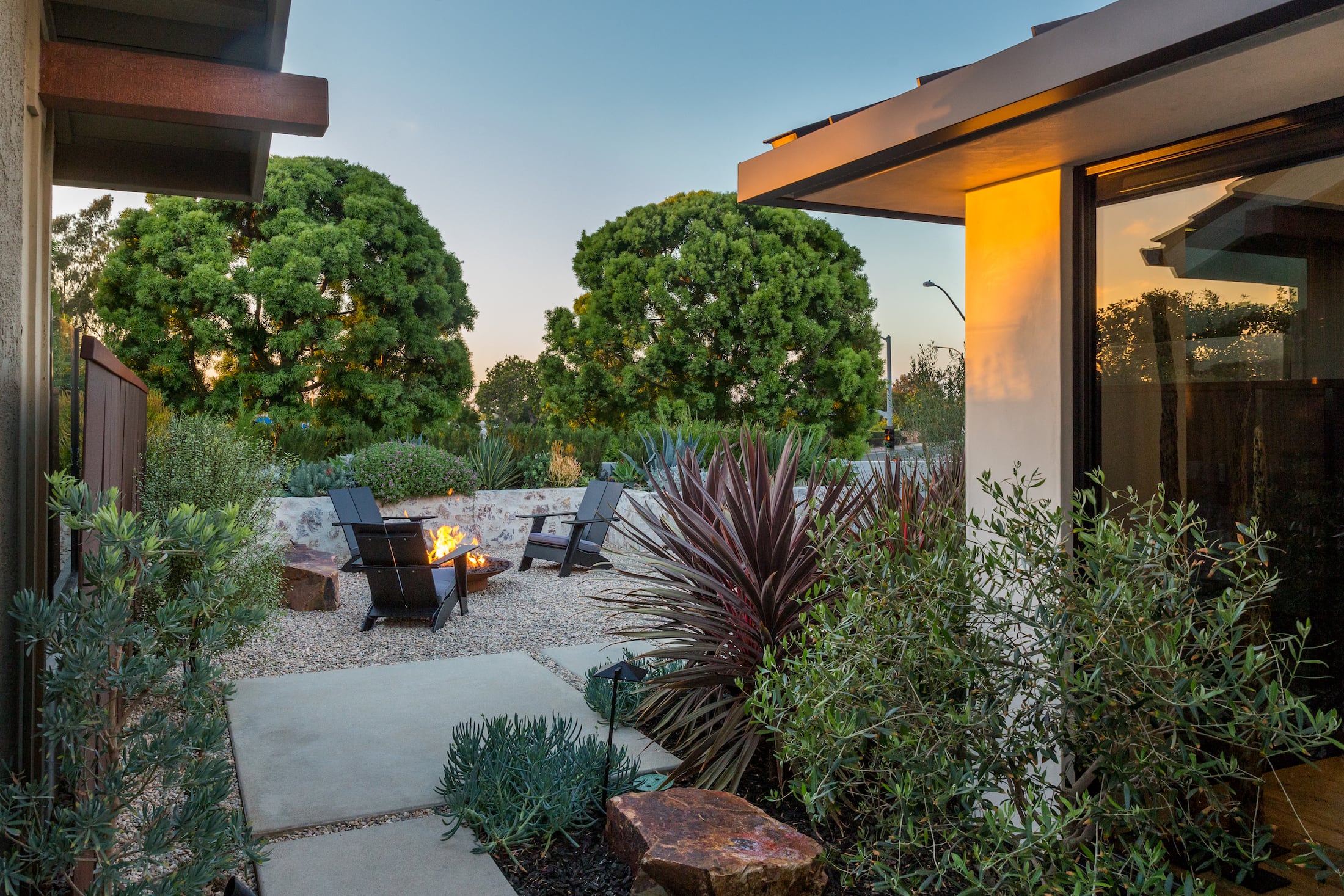
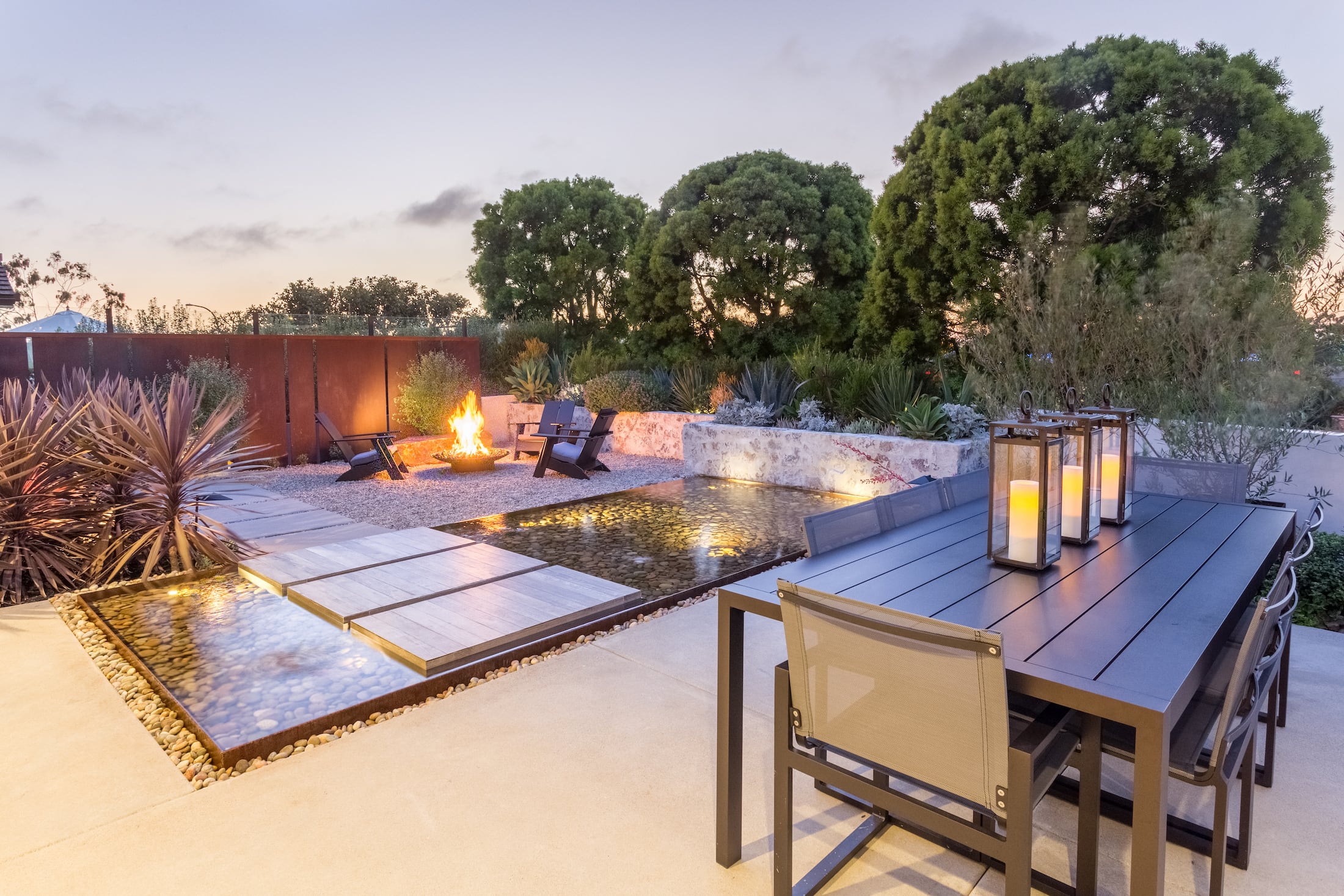
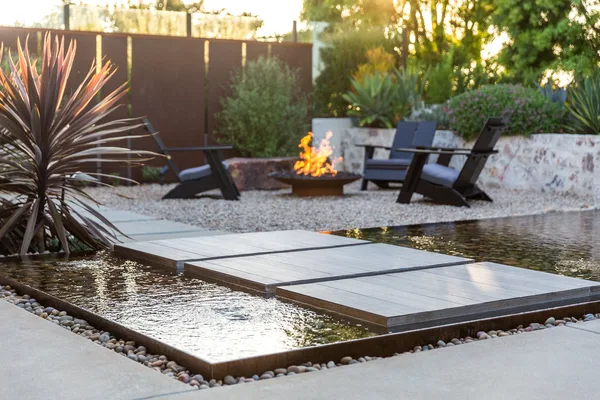
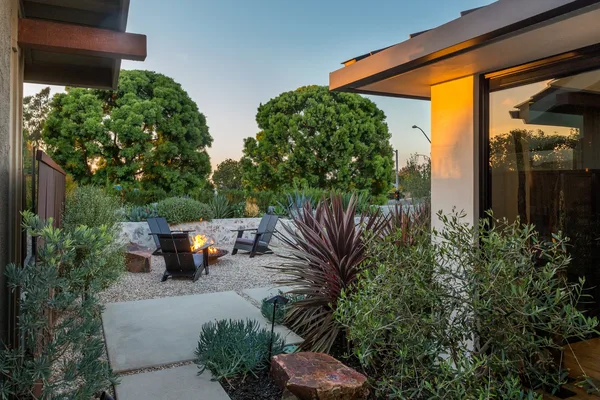
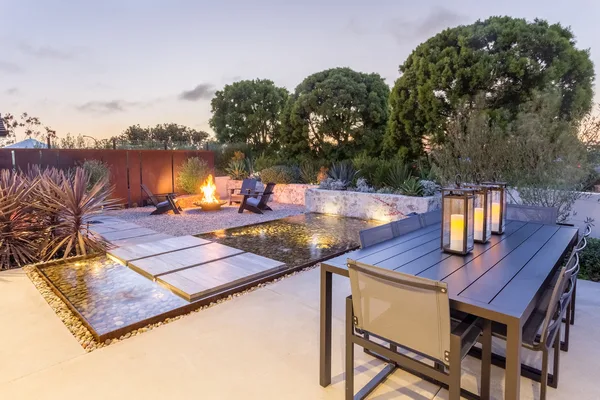
This contemporary Orange County garden shows what a landscape can do without a swimming pool. A shallow pond lined with river pebbles lies between the dining terrace and a fire bowl. Broad rectangular pads cross the water. On the far side, dark chairs sit on gravel around a low fire. A second path reaches the same seats through the planting. At the front of the house, another pond runs beside the entry walk under a natural stone wall. The planting is sculptural and drought-tolerant: succulents, grasses and bold foliage in gravel and dark mulch.
This case study explains how a shallow water garden is built, and how it differs from a pool.
At a glance
- The setting: A modern home in Orange County with living rooms that open directly to the garden.
- The scope: Dining terrace, shallow pebble-lined pond with stepping pads, fire bowl seating area, garden path, entry pond and stone wall, stepping-stone entry walk, metal planters, drought-tolerant planting and lighting.
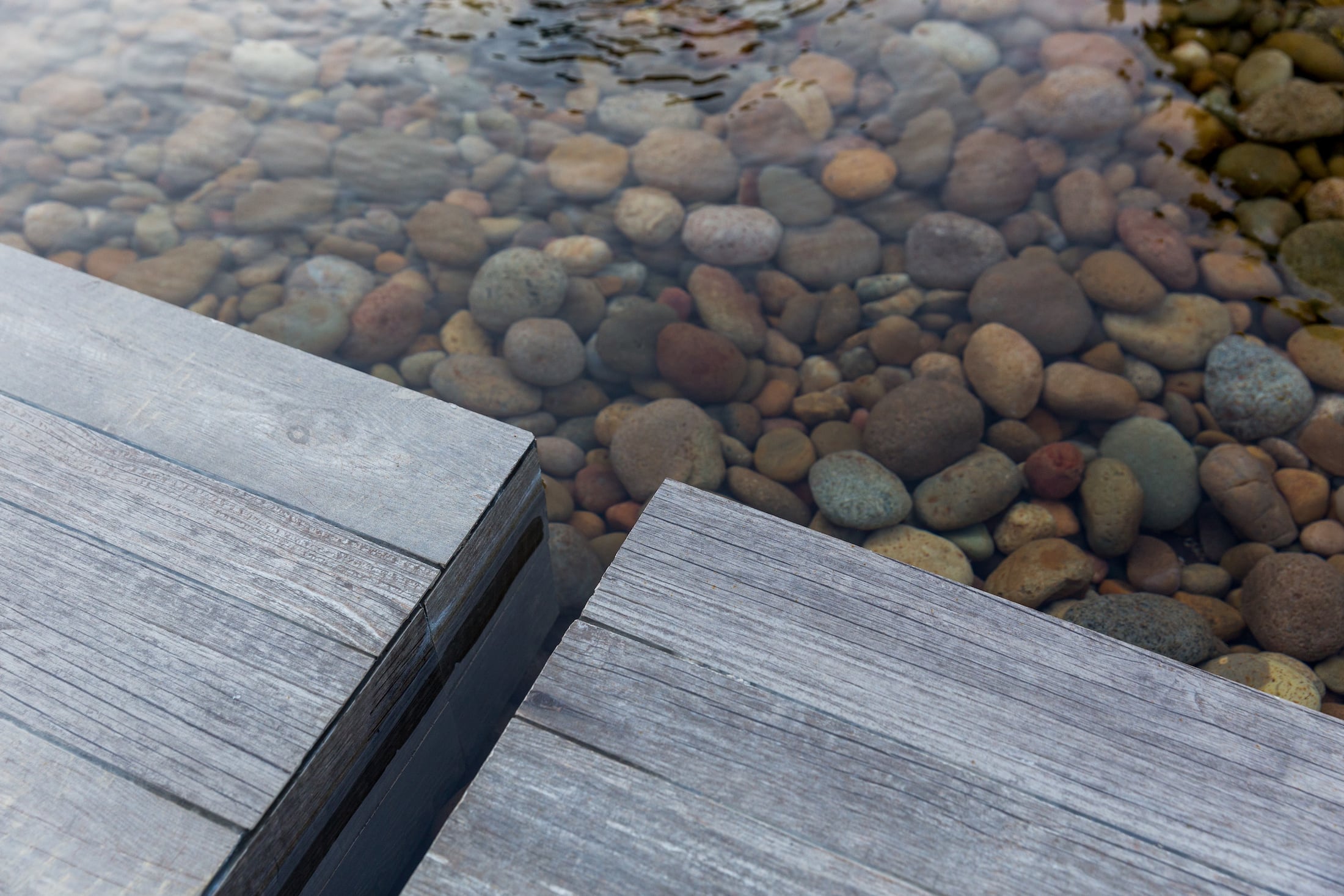
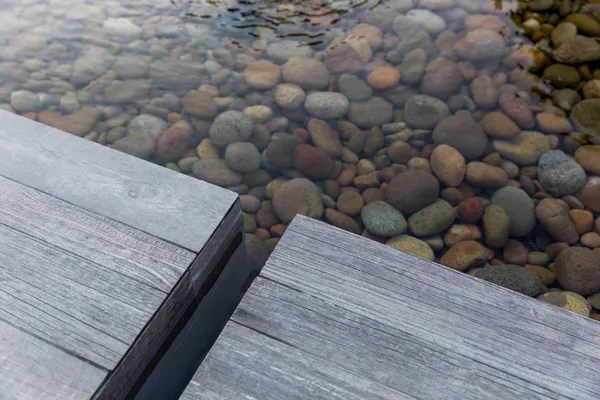
- The signature detail: A narrow, even gap between stepping pads, with water and rounded pebbles visible below.
- Location: Orange County, California.
A small garden with two ways to cross it.
The dining table, the water and the fire are within a few steps of one another. From the table, the fire bowl is the next destination, close enough to walk to with a glass in hand. The pond sits between them, and it changes the short walk into something worth doing slowly.
There are two routes. The direct one is over the water on the pads. The other leaves the terrace to one side and runs through the planting, with foliage close on both sides, and arrives at the chairs from the garden. Both end at the same seats. A guest who would prefer firm ground the whole way has it, and nobody is sent around the back.
The materials are few and matte: pale concrete paving, weathered-finish pads, warm rust-colored screens, natural stone walls, gravel, and river pebbles in gray, tan and rust. Against them, the water and the fire are the only things that move.
Why a pond and not a pool?
- It fits. A shallow water garden can go where a swimming pool cannot, including small yards, entry courts and side gardens.
- It is seen from indoors. At a few inches deep, a pond sits at floor level right outside the glass and reflects the sky into the room.
- It uses less. A small volume of water needs a small pump and little energy, and it loses less to evaporation than a large pool.
- It suits a dry garden. Still water beside drought-tolerant planting gives a garden a cool center without a lawn.
A shallow ornamental pond is a different structure from a swimming pool, and local rules treat the two differently depending on depth. We confirm the requirements for each project before design is final.
The build, layer by layer.
01. Set the water level to the house
The finished water level, the top of the pads and the terrace are set from the interior floor. In a modern house with large sliding doors, a difference of an inch between inside and outside is visible. Drainage is planned so that neither the pond nor the terrace can send water toward the door, even if the pond overfills in a storm.
02. Excavate and form the basin
The basin is shallow, but it is still a reinforced concrete vessel. It is formed with level edges, a slight fall in the floor toward a drain, and a recessed area for the intake so pebbles do not block it. The supports for the stepping pads are formed and poured with the basin.
03. Plumb for clear, quiet water
A pond needs circulation and filtration to stay clear. Supply and return lines, an overflow, an automatic fill and a drain are installed, with the pump and filter located out of sight. The returns are placed to move water gently across the whole basin so there are no stagnant corners.
04. Waterproof the basin
The concrete is waterproofed with LATICRETE HYDRO BAN. In a shallow pond with a pebble floor, the waterproofing is never seen, and it has to be right, since finding a leak under a bed of pebbles is slow work. The basin is filled and held for a test period before any finish goes in.
05. Build the walls and screens
The natural stone walls at the entry and the garden are built on their own footings and laid dry-looking, with tight, raked joints. The warm-toned metal screens and the long metal planter are fabricated, set on concealed footings and kept clear of irrigation spray. Where a wall rises from the pond, it is waterproofed below the waterline.
06. Set the pads
The pads are set on their supports to a string line, level with the terrace and with each other. The gap between pads is held to one width. That gap is looked at from above with every step and from the side throughout a meal, so it has to be straight and even. The pad surface has a textured finish for grip.
07. Pave the terrace and lay the paths
The dining terrace is paved over a concrete subbase, with RedGard anti-fracture membrane where the finish is mortar-set. The garden path is a firm, even surface suited to anyone, bordered with planting. The fire seating area is finished in compacted gravel over a prepared base, edged so the gravel stays put.
08. Install the fire bowl
The fire bowl sits on a level pad with a gas line, a shut-off valve nearby and drainage so rainwater does not collect. The gas line is sized for the burner and the length of the run. Clearance around the bowl follows the manufacturer's instructions, and the chairs are placed on gravel, which will not burn.
09. Place the pebbles and the boulders
River pebbles are washed and placed by hand across the basin floor, with larger stones at the edges and around the pad supports to hide them. Colors are mixed so no patch looks sorted. In the garden, landscape boulders are set partly buried, as they would sit in nature.
10. Plant the dry garden
The planting is chosen for form and for low water use: succulent rosettes, bronze and red strappy foliage, olive and silver shrubs, and grasses. Plants are spaced for their mature size. Beds are finished in gravel or dark mulch and watered by drip irrigation, zoned so succulents are not watered like shrubs.
11. Light it and hand over
Lighting is low and warm: small fixtures grazing the stone walls, soft light at the edge of the pond, and uplights on a few specimen plants. With lanterns on the table and the fire lit, the garden needs very little else. We walk the owner through the pond equipment, the fire bowl and the irrigation controller.
Where water gardens go wrong, and how we avoid it.
Green water. A shallow pond in full sun grows algae quickly if the water is not circulated and filtered. We size the pump and filter for the volume, and we give the owner a simple maintenance routine.
A basin that leaks. Shallow does not mean simple. We waterproof the concrete and water-test the basin before pebbles and pads go in.
Pebbles in the pump. Loose stone migrates. We protect the intake and drain with a recessed, screened sump.
Overflow toward the house. In a storm, a pond at floor level can fill. An overflow line set just above the normal water level carries the excess to the drainage system.
Pads that rock or sit unevenly. Each pad is fully supported and set to a common line. We check them underfoot before the pond is filled.
Thirsty plants in a dry garden. One plant that needs daily water forces the whole zone to get it. We group plants by need.
Quiet by design.
The finished garden is calm in daylight and warm at night. From inside the house, the pond reflects the sky. From the table, the fire is a short walk away. The planting gives color and shape through the year with very little water.
More photographs, including the entry pond and the stone wall, are in the project gallery.
Caring for a water garden and a dry garden.
A shallow pond is simple to keep when it is looked at often. Skim leaves from the surface every few days, and empty the pump basket weekly. Keep the water level steady and confirm the automatic fill is working, since a shallow basin shows a small drop quickly. Clean or backwash the filter on the schedule its maker recommends. In warm weather, more sun means more algae, so circulation time may need to be longer in summer than in winter.
Once or twice a year, the pebbles benefit from a rinse. Sediment settles between them over time. A service company can vacuum the basin without disturbing the stone. Check the gaps between pads for trapped leaves, and look at the pad surfaces for any buildup that could make them slick.
The fire bowl needs little: keep the burner and the drain clear, cover the bowl when it will not be used for a while, and have the gas connection checked periodically. Keep the gravel around it raked level and topped up.
The dry garden asks for restraint. Most losses in drought-tolerant planting come from too much water, not too little. Water deeply and infrequently once plants are established, and reduce irrigation sharply in the cool season. Remove spent flower stalks from succulents, divide clumps that outgrow their place, and cut back grasses once a year. Renew gravel or mulch where it thins, and keep irrigation spray off metal screens and planters so they weather evenly.
We do not provide weekly service. We are glad to recommend maintenance companies that understand ponds and low-water gardens.
What would you change about your garden?
- Replacing lawn with a water garden and drought-tolerant planting
- Adding a reflecting pond beside an entry walk
- Building a fire bowl seating area
- Creating two routes through a small garden
- Adding stone walls, metal screens or planters
Questions homeowners ask about water gardens
How deep is a reflecting pond?
Ornamental reflecting ponds are usually only a few inches deep. That is enough to cover a pebble floor and reflect the sky. Local codes treat water features differently according to depth, so we confirm the rules for your city before we design.
How do you keep a shallow pond clean?
With circulation, filtration and regular skimming, much like a small pool. An automatic fill keeps the level steady. We do not provide weekly service, and we are glad to recommend maintenance companies.
Can a garden feel complete without a pool or a lawn?
Yes. Water, fire, good paving and strong planting make a complete garden. This project has no swimming pool and very little lawn.
What plants work in a drought-tolerant Orange County garden?
Succulents such as agave, aloe and echeveria, ornamental grasses, olive, and many Mediterranean and Australian shrubs do well. We choose plants for the site's sun, soil and exposure, and group them by water need.
Love your home. Rethink your yard.
Every project begins with a complimentary site visit. From that visit we prepare a complimentary, detailed scope of work and budget, so you know what the project includes before any design work starts.
Request a Complimentary Site Visit. Call 800-808-7510 or email info@richardlusk.com.
Richard Lusk Landscape and Design has been building pools and landscapes since 1976, with more than 3,000 projects completed. California contractor license 950714, C-27 Landscaping and C-53 Swimming Pool. Bonded and insured. Serving Orange County, selected Los Angeles communities and La Quinta.